
Ever wondered how you can sprint down a football pitch,...
 LCPE2 visualizaciones·Actualizado Jun 9, 2026·6 páginas
Understanding the Muscular System: Muscle Groups and Movements

1 / 6
1
of 6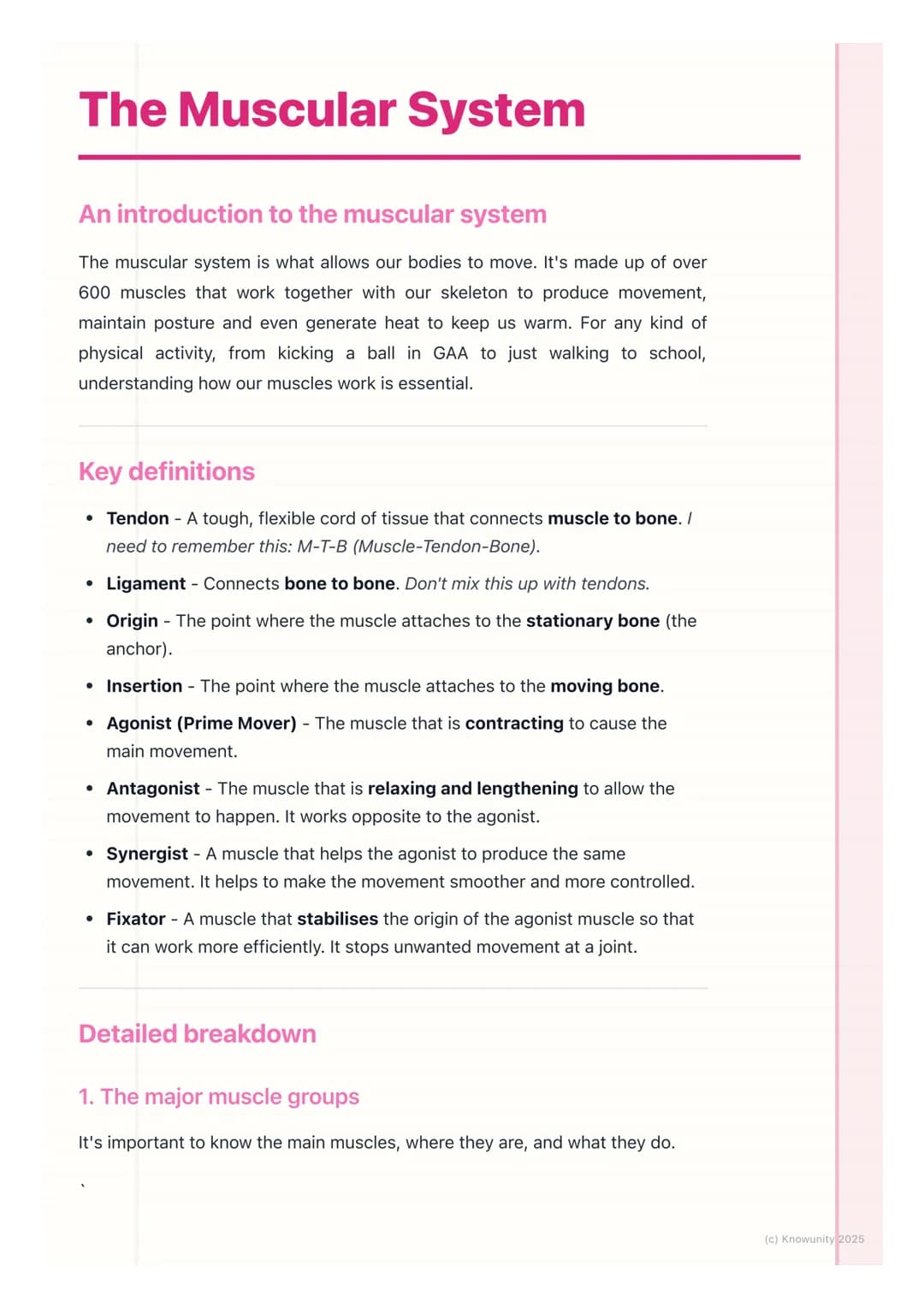
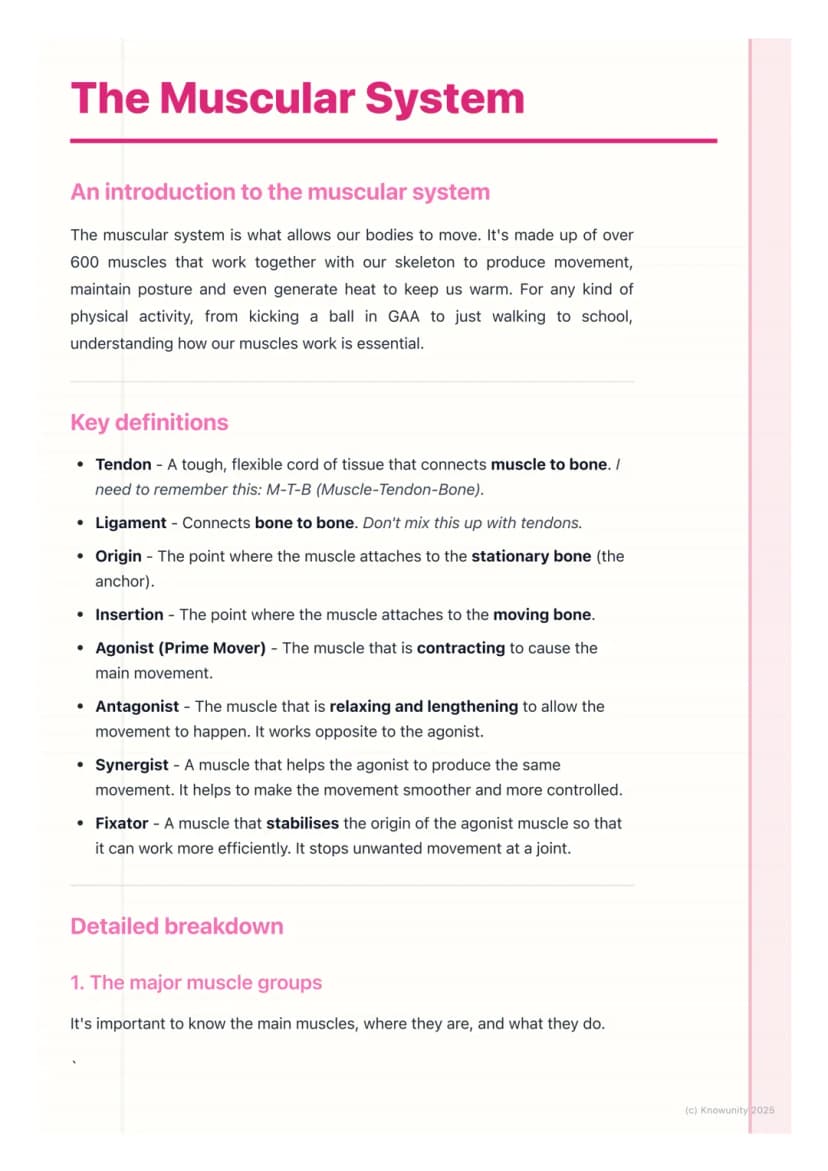
The Muscular System Basics
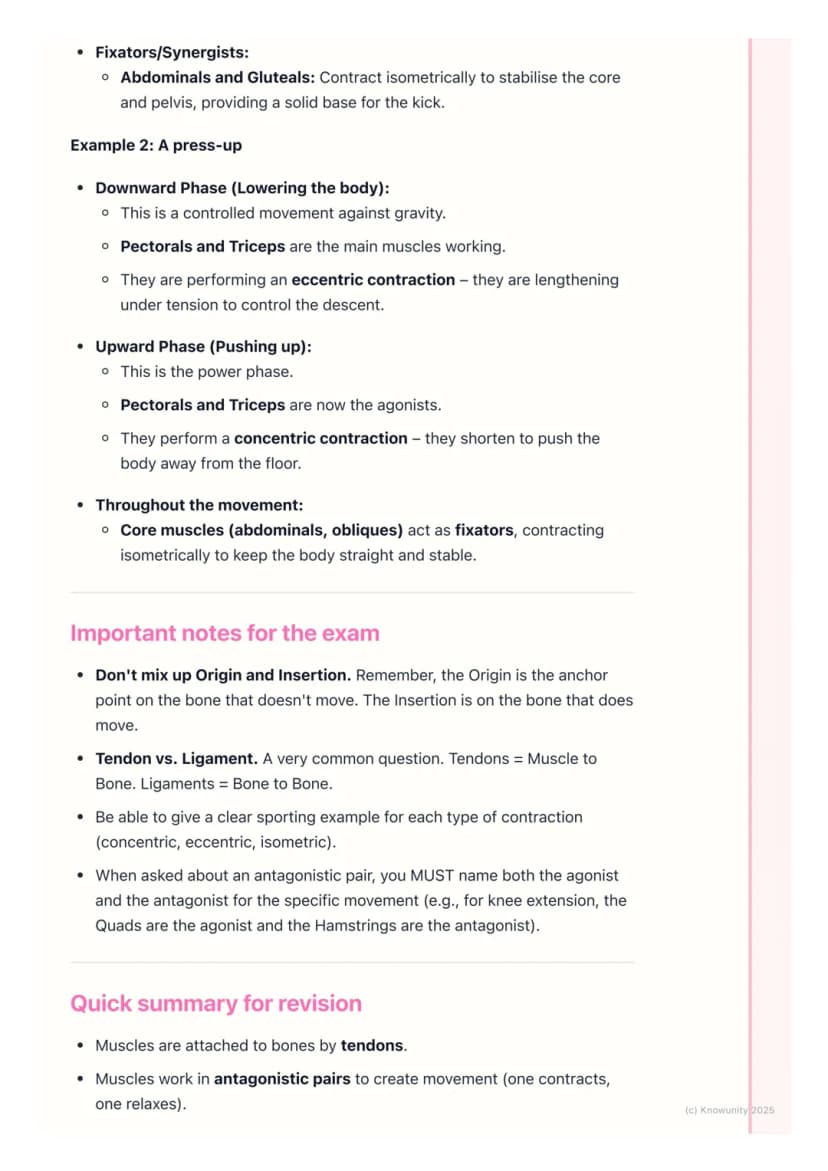
Your muscles are the engines of movement, and understanding how they work is crucial for any sport or physical activity. The muscular system connects to your skeleton through tendons (muscle to bone) and works with ligaments (bone to bone) to create coordinated movement.
Each muscle has two key attachment points: the origin (the anchor point on the stationary bone) and the insertion (where it attaches to the moving bone). Think of it like a rope - one end stays fixed whilst the other pulls.
Muscles work in teams too. The agonist is your main worker muscle that contracts to create movement, whilst the antagonist relaxes to allow that movement to happen. Synergist muscles help out, and fixators keep everything stable and controlled.
Quick Tip: Remember M-T-B to never mix up tendons and ligaments again!
2
of 6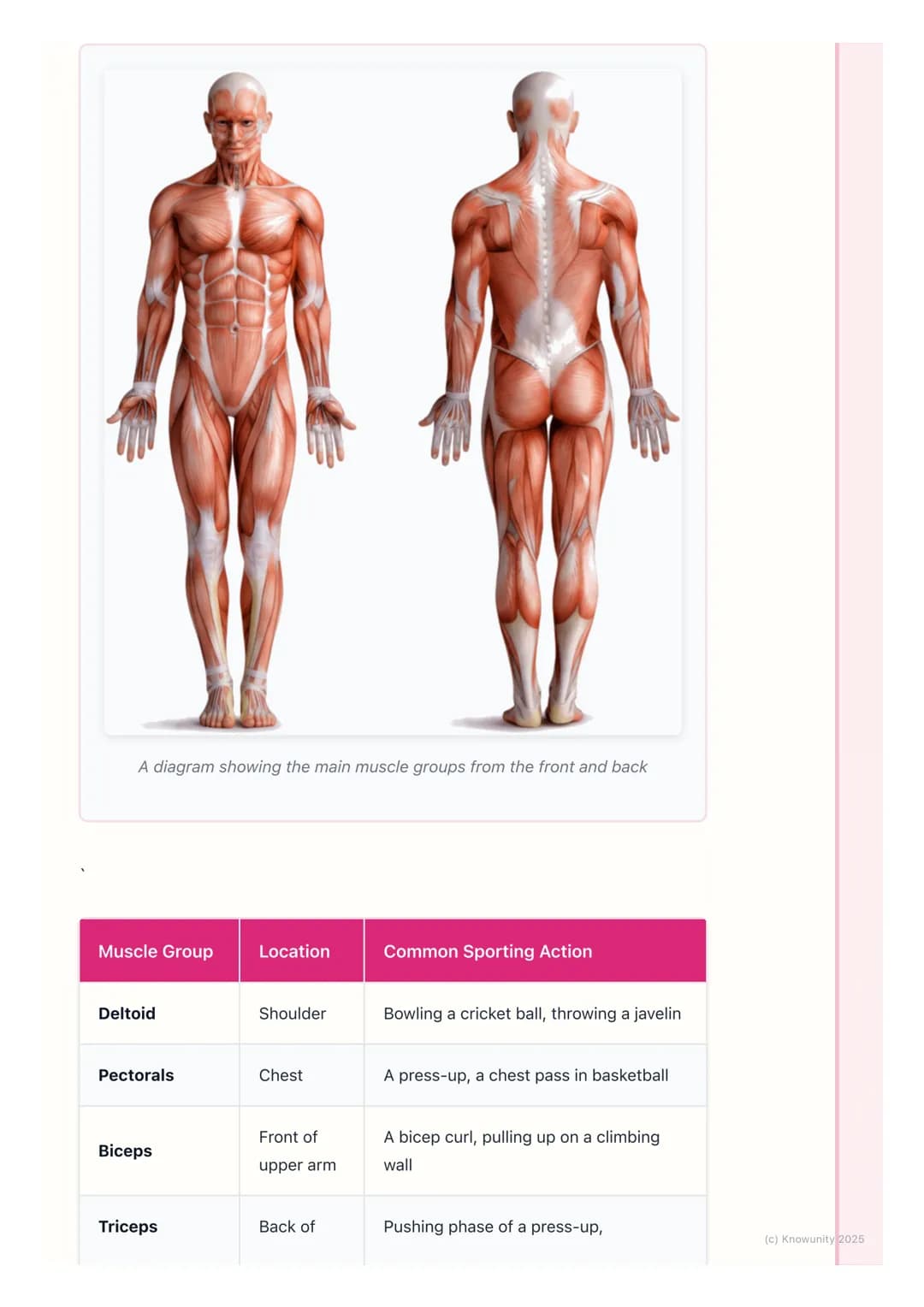
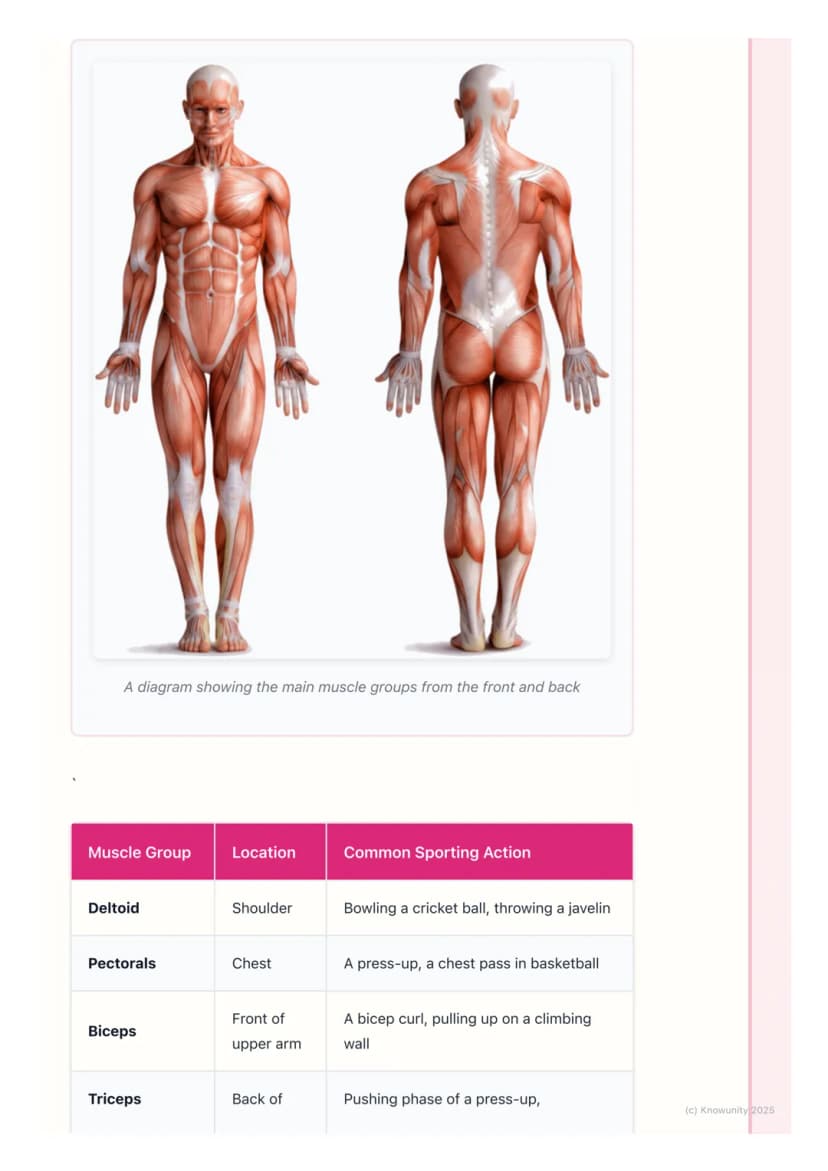
Major Muscle Groups You Need to Know
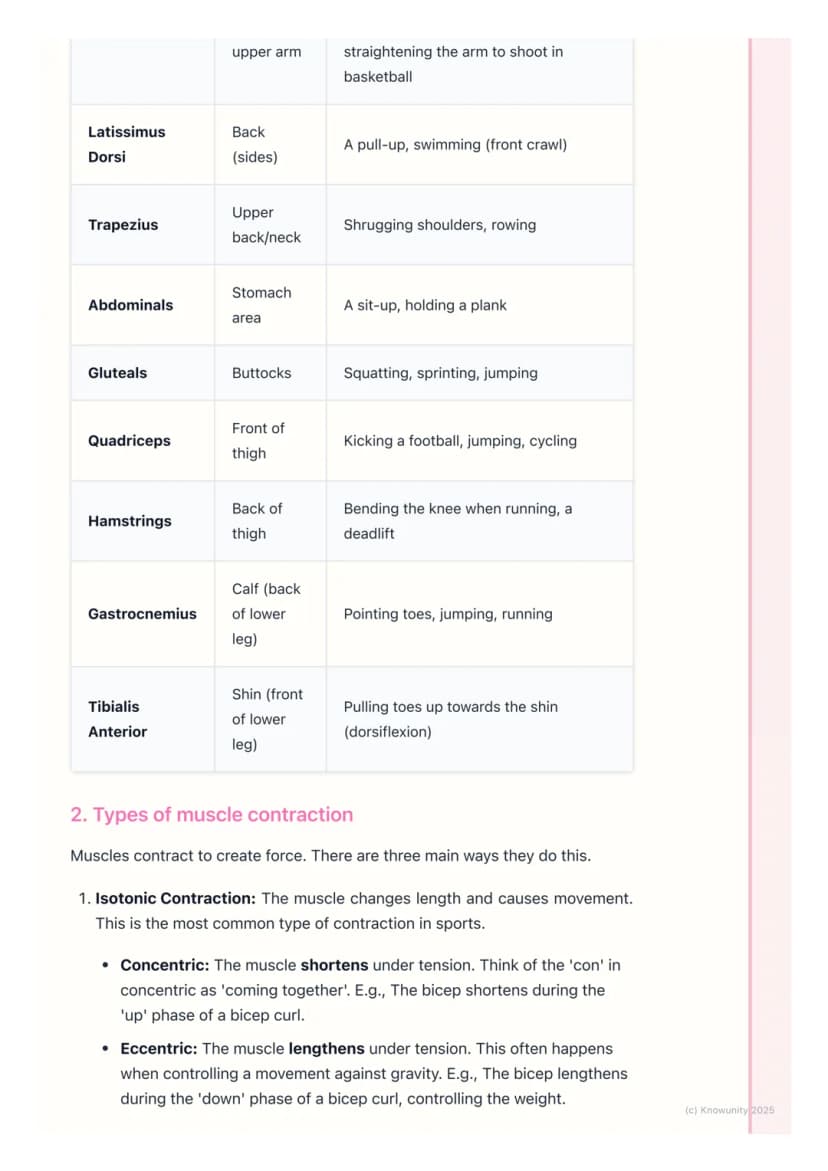
Knowing where your major muscles are and what they do makes understanding movement so much easier. Your deltoids in your shoulders power overhead throws, whilst your pectorals across your chest drive push-ups and chest passes.
Your arms have the classic pair everyone knows - biceps at the front for pulling movements like chin-ups, and triceps at the back for pushing actions like shooting in basketball. Down your torso, the latissimus dorsi (or 'lats') along your back handle pull-ups and swimming strokes.
Your core abdominals and powerful gluteals provide stability and explosive power for jumping and sprinting. Finally, your legs house the mighty quadriceps at the front for kicking and jumping, hamstrings at the back for knee bending, and your gastrocnemius (calf muscles) for pointing toes and explosive movements.
Exam Hint: You'll likely need to identify these muscles and give sporting examples of their actions - start practising now!
3
of 6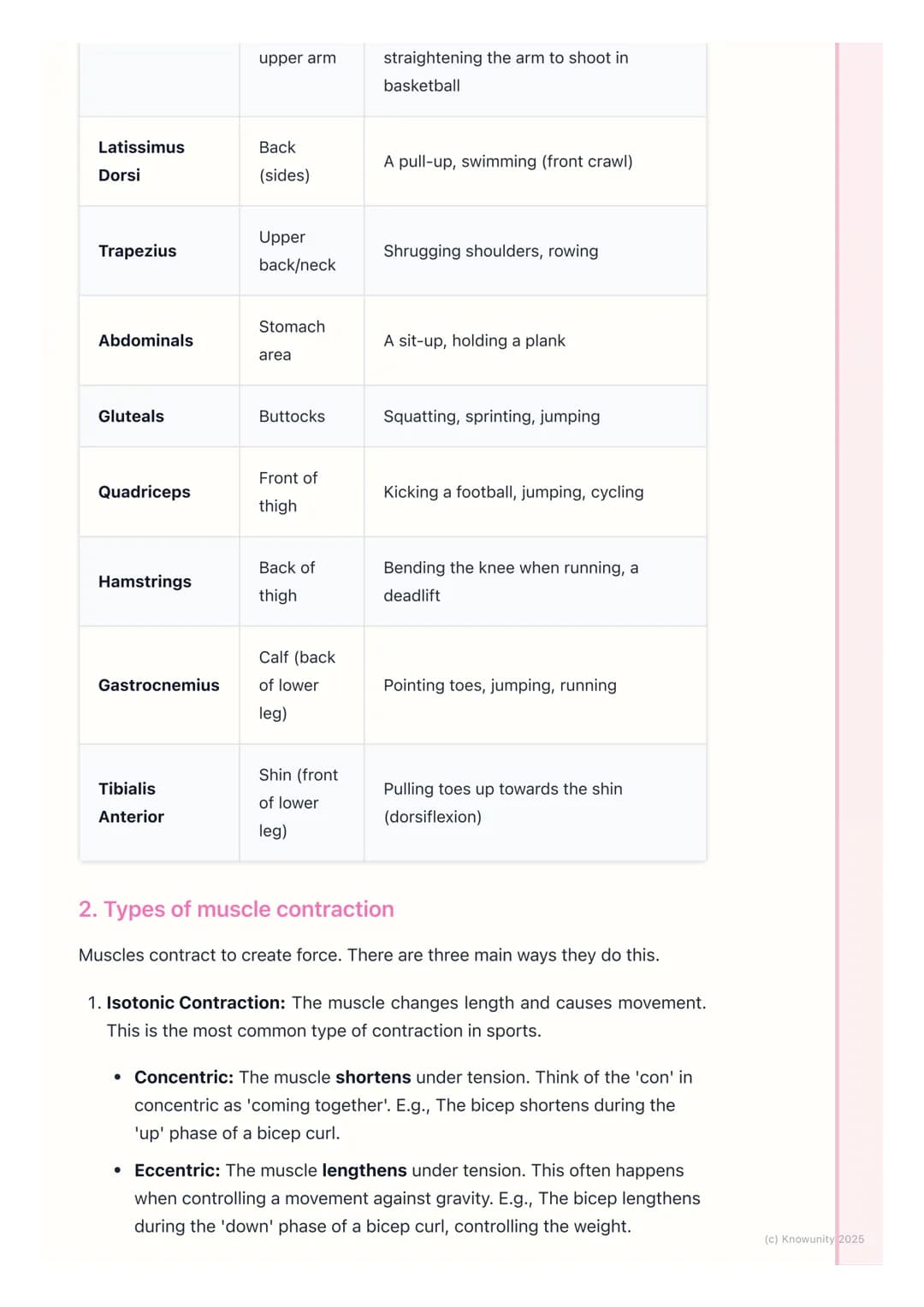
Types of Muscle Contraction
Muscles create force in three distinct ways, and each type appears constantly in sport. Isotonic contractions involve movement and come in two flavours that you'll recognise immediately from your training.
Concentric contractions happen when muscles shorten under tension - think 'coming together'. During the lifting phase of a bicep curl, your bicep shortens as it pulls the weight up. Eccentric contractions occur when muscles lengthen whilst still working hard, like controlling the weight down in that same bicep curl.
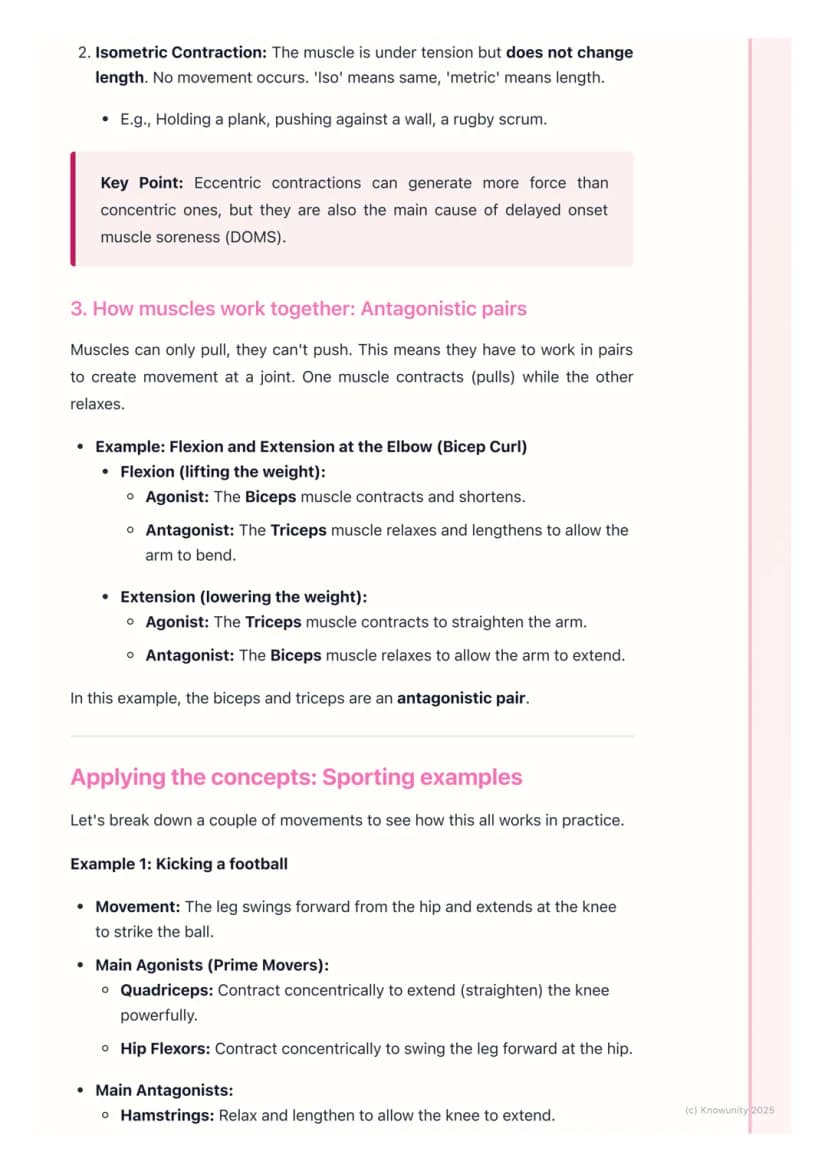
Isometric contractions create no movement at all - the muscle stays the same length . Holding a plank, pushing against a wall, or staying solid in a rugby scrum are perfect examples.
Here's something fascinating: eccentric contractions actually generate more force than concentric ones, but they're also what causes that muscle soreness (DOMS) you feel after intense training.
Remember This: Muscles can only pull, never push - this is why they must work in pairs!
4
of 6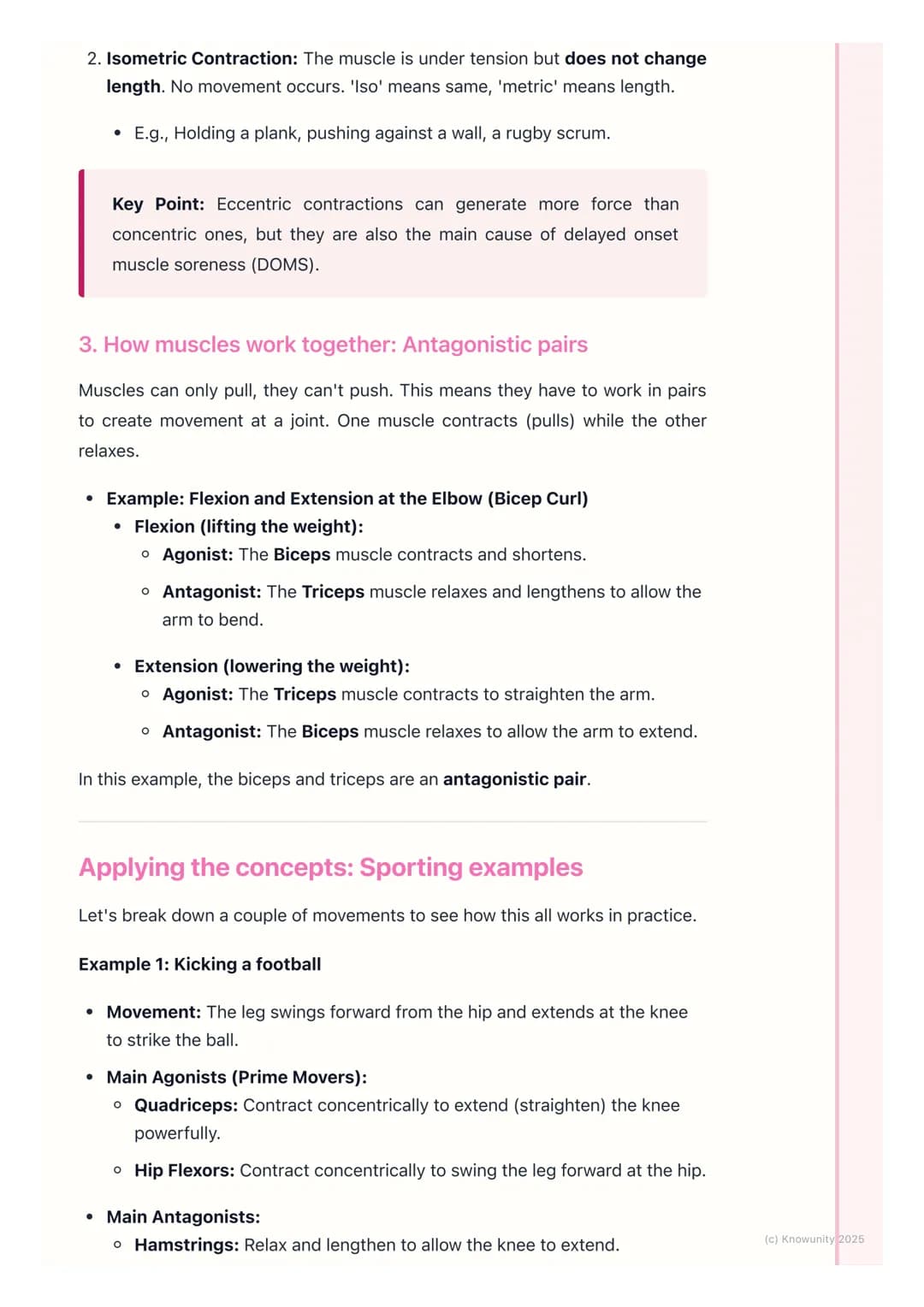
Antagonistic Pairs in Action
Since muscles can only pull, they work in antagonistic pairs where one contracts whilst its partner relaxes. This partnership creates smooth, controlled movement at every joint.
Take a bicep curl: during flexion (lifting), your biceps acts as the agonist, contracting concentrically whilst your triceps (the antagonist) relaxes and lengthens. When you lower the weight, the roles don't simply reverse - your triceps becomes the agonist, contracting to control the descent.
Let's apply this to kicking a football. Your quadriceps fire concentrically as the main agonist to straighten your knee powerfully, whilst your hamstrings relax as the antagonist. Meanwhile, your hip flexors swing your leg forward, and your core muscles act as fixators, contracting isometrically to provide a stable base.
During a press-up, your pectorals and triceps work eccentrically on the way down (controlling against gravity) then concentrically pushing back up, whilst your core muscles remain contracted isometrically throughout to keep you rigid.
Exam Success: Always name both muscles in an antagonistic pair and specify which is the agonist for the movement you're describing!
5
of 6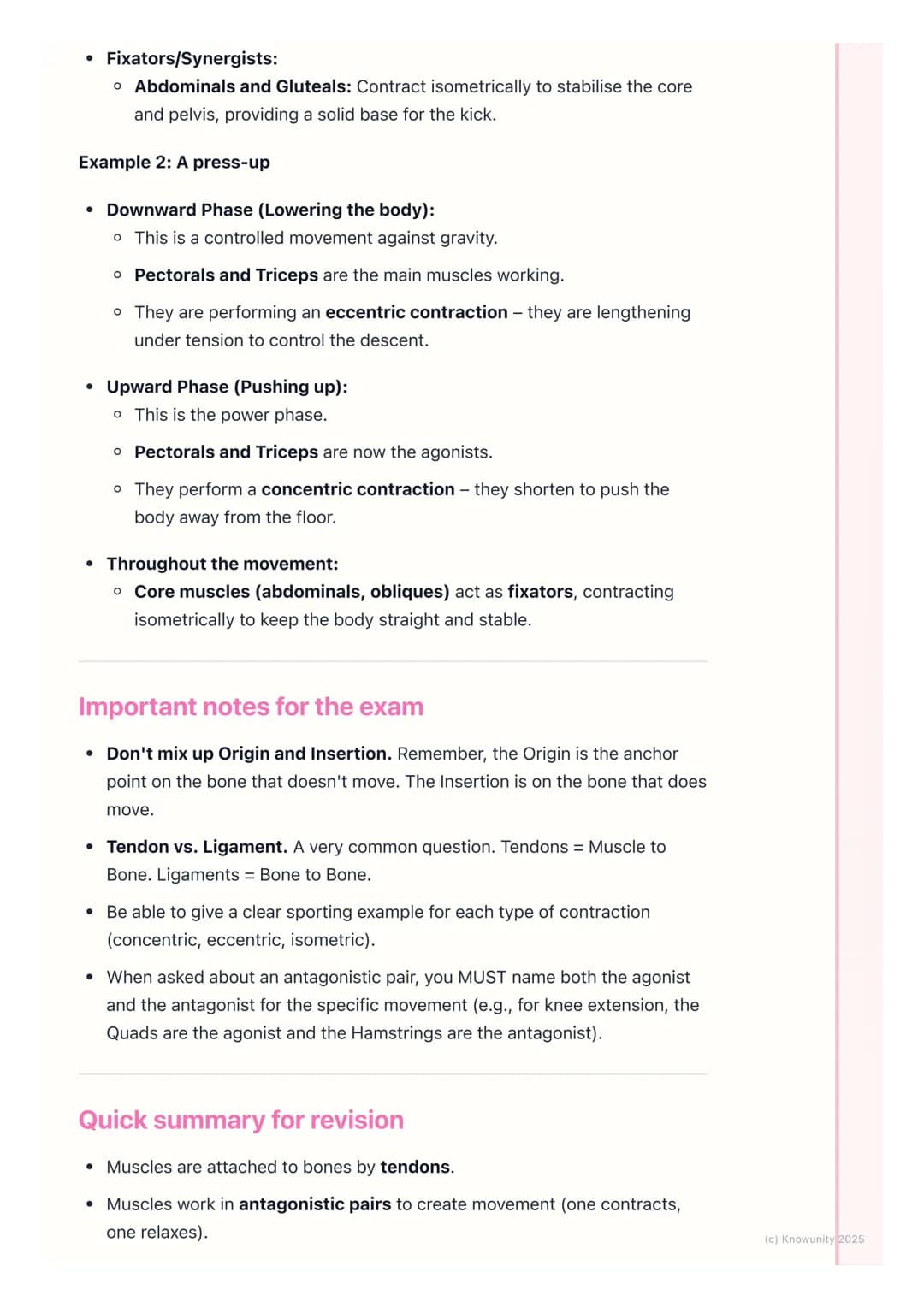
Key Points for Your Exams
Don't let simple mix-ups cost you marks. Origin always refers to the anchor point on the stationary bone, whilst insertion is where the muscle attaches to the moving bone. Tendons connect muscle to bone, ligaments connect bone to bone.
Be ready to give clear sporting examples for each contraction type. Concentric: the upward phase of a squat. Eccentric: controlling the descent in a squat. Isometric: holding a wall sit. These examples show you understand the concepts in real-world contexts.
When discussing antagonistic pairs, remember the key combinations: biceps/triceps at the elbow, quadriceps/hamstrings at the knee. You must identify which muscle is the agonist for the specific movement being described.
Fixator muscles deserve special mention - they're the unsung heroes that stabilise your body during movement, preventing unwanted motion and making your primary muscles more efficient.
Revision Strategy: Practice identifying muscle actions in your favourite sports - it makes the theory stick and shows real understanding!
6
of 6
Quick Revision Summary
Your muscular system is all about teamwork and coordination. Tendons attach muscles to bones, creating the connections needed for movement, whilst muscles work in antagonistic pairs where one contracts as its partner relaxes.
Master the three contraction types: concentric (muscle shortens during movement), eccentric (muscle lengthens whilst controlling movement), and isometric (muscle contracts but length stays constant). Each type appears constantly in sport and daily life.
Key muscle pairs to memorise include biceps/triceps for elbow movement and quadriceps/hamstrings for knee actions. Don't forget that fixators provide crucial stability during all movements, acting as your body's natural stabilisers.
Understanding these concepts helps you analyse any sporting movement, from a simple press-up to complex GAA skills. The muscular system isn't just theory - it's the foundation of every athletic performance you'll ever watch or participate in.
Final Tip: Connect every concept to movements you know well - it transforms abstract theory into practical knowledge you'll never forget!
Pensamos que nunca lo preguntarías...
¿Qué es Knowunity AI companion?
Nuestro compañero de IA está específicamente adaptado a las necesidades de los estudiantes. Basándonos en los millones de contenidos que tenemos en la plataforma, podemos dar a los estudiantes respuestas realmente significativas y relevantes. Pero no se trata solo de respuestas, el compañero también guía a los estudiantes a través de sus retos de aprendizaje diarios, con planes de aprendizaje personalizados, cuestionarios o contenidos en el chat y una personalización del 100% basada en las habilidades y el desarrollo de los estudiantes.
¿Dónde puedo descargar la app Knowunity?
Puedes descargar la app en Google Play Store y Apple App Store.
¿Knowunity es totalmente gratuito?
¡Sí lo es! Tienes acceso totalmente gratuito a todo el contenido de la app, puedes chatear con otros alumnos y recibir ayuda inmeditamente. Puedes ganar dinero utilizando la aplicación, que te permitirá acceder a determinadas funciones.
Contenidos más populares de LCPE
4LCPEHealthy Eating Guidelines
This section explores national healthy eating guidelines, such as the food pyramid or healthy eating plate, to promote balanced dietary choices.
5th Year50
LCPEBiomechanics of Movement
Applying fundamental biomechanical principles such as force, motion, levers, and stability to analyse and improve human movement efficiency and performance in sport.
6th Year200
LCPEFactors effecting sports psychology ( confidence and self efficacy)
Higher Level LCPE psychological preprration notes
5th Year230
LCPETechnology in Sport
Investigating how technology is used in areas such as performance analysis, equipment design, officiating, and athlete monitoring to enhance training and competition.
6th Year50
Contenidos más populares
9 Irish
IrishIrish oral questions and answers
Questions and answers for the leaving cert oral
5th Year4264
 English
Key Quotes : Sive
Key Quotes and explanations: Sive
6th Year2842
IrishIrish oral questions
Outline of oral questions
5th Year2055
IrishIníon- le hÁine Durkin
Aine Durkin’s poem, Iníon: Themes & summary
5th Year850
IrishIrish poetry 2027
Iníon + Dínit an Bhróin
5th Year1133
IrishLC HL notes- Iníon (poem)
Includes poem in English and Irish, theme, key words & phrases
5th Year2284
EnglishCultural Context : Shawshank Redemption : Sive : Small Things Like These
Comparative Study : Cultural Context : Shawshank Redemption, Sive and Small Things Like These
6th Year1430
IrishMo Ghrá-sa (Idir Lúibíní)
Notes on mo ghrá-sa
5th Year380
IrishAn Gaeilge Aiste
Irish Language essay
6th Year1320
¿No encuentras lo que buscas? Explora otros temas.
Mira lo que dicen nuestros usuarios. Les encantó — y a ti también te encantará.
4.6/5App Store
4.7/5Google Play
La app es muy fácil de usar y está muy bien diseñada. Hasta ahora he encontrado todo lo que estaba buscando y he podido aprender mucho de las presentaciones. Definitivamente utilizaré la aplicación para un examen de clase. Y, por supuesto, también me sirve mucho de inspiración.
Pablousuario de iOS
Esta app es realmente genial. Hay tantos apuntes de clase y ayuda [...]. Tengo problemas con matemáticas, por ejemplo, y la aplicación tiene muchas opciones de ayuda. Gracias a Knowunity, he mejorado en mates. Se la recomiendo a todo el mundo.
Elenausuaria de Android
Vaya, estoy realmente sorprendida. Acabo de probar la app porque la he visto anunciada muchas veces y me he quedado absolutamente alucinada. Esta app es LA AYUDA que quieres para el insti y, sobre todo, ofrece muchísimas cosas, como ejercicios y hojas informativas, que a mí personalmente me han sido MUY útiles.
Anausuaria de iOS
LCPE2 visualizaciones·Actualizado Jun 9, 2026·6 páginasUnderstanding the Muscular System: Muscle Groups and Movements
Ever wondered how you can sprint down a football pitch, hold a perfect plank, or throw a sliotar with precision? It's all down to your muscular system - a network of over 600 muscles working together to create movement, maintain...
1
of 6
Inscríbete para ver los apuntes. ¡Es gratis!
- Acceso a todos los documentos
- Mejora tus notas
- Únete a millones de estudiantes
The Muscular System Basics
Your muscles are the engines of movement, and understanding how they work is crucial for any sport or physical activity. The muscular system connects to your skeleton through tendons (muscle to bone) and works with ligaments (bone to bone) to create coordinated movement.
Each muscle has two key attachment points: the origin (the anchor point on the stationary bone) and the insertion (where it attaches to the moving bone). Think of it like a rope - one end stays fixed whilst the other pulls.
Muscles work in teams too. The agonist is your main worker muscle that contracts to create movement, whilst the antagonist relaxes to allow that movement to happen. Synergist muscles help out, and fixators keep everything stable and controlled.
Quick Tip: Remember M-T-B to never mix up tendons and ligaments again!
2
of 6Inscríbete para ver los apuntes. ¡Es gratis!
- Acceso a todos los documentos
- Mejora tus notas
- Únete a millones de estudiantes
Major Muscle Groups You Need to Know
Knowing where your major muscles are and what they do makes understanding movement so much easier. Your deltoids in your shoulders power overhead throws, whilst your pectorals across your chest drive push-ups and chest passes.
Your arms have the classic pair everyone knows - biceps at the front for pulling movements like chin-ups, and triceps at the back for pushing actions like shooting in basketball. Down your torso, the latissimus dorsi (or 'lats') along your back handle pull-ups and swimming strokes.
Your core abdominals and powerful gluteals provide stability and explosive power for jumping and sprinting. Finally, your legs house the mighty quadriceps at the front for kicking and jumping, hamstrings at the back for knee bending, and your gastrocnemius (calf muscles) for pointing toes and explosive movements.
Exam Hint: You'll likely need to identify these muscles and give sporting examples of their actions - start practising now!
3
of 6Inscríbete para ver los apuntes. ¡Es gratis!
- Acceso a todos los documentos
- Mejora tus notas
- Únete a millones de estudiantes
Types of Muscle Contraction
Muscles create force in three distinct ways, and each type appears constantly in sport. Isotonic contractions involve movement and come in two flavours that you'll recognise immediately from your training.
Concentric contractions happen when muscles shorten under tension - think 'coming together'. During the lifting phase of a bicep curl, your bicep shortens as it pulls the weight up. Eccentric contractions occur when muscles lengthen whilst still working hard, like controlling the weight down in that same bicep curl.
Isometric contractions create no movement at all - the muscle stays the same length . Holding a plank, pushing against a wall, or staying solid in a rugby scrum are perfect examples.
Here's something fascinating: eccentric contractions actually generate more force than concentric ones, but they're also what causes that muscle soreness (DOMS) you feel after intense training.
Remember This: Muscles can only pull, never push - this is why they must work in pairs!
4
of 6Inscríbete para ver los apuntes. ¡Es gratis!
- Acceso a todos los documentos
- Mejora tus notas
- Únete a millones de estudiantes
Antagonistic Pairs in Action
Since muscles can only pull, they work in antagonistic pairs where one contracts whilst its partner relaxes. This partnership creates smooth, controlled movement at every joint.
Take a bicep curl: during flexion (lifting), your biceps acts as the agonist, contracting concentrically whilst your triceps (the antagonist) relaxes and lengthens. When you lower the weight, the roles don't simply reverse - your triceps becomes the agonist, contracting to control the descent.
Let's apply this to kicking a football. Your quadriceps fire concentrically as the main agonist to straighten your knee powerfully, whilst your hamstrings relax as the antagonist. Meanwhile, your hip flexors swing your leg forward, and your core muscles act as fixators, contracting isometrically to provide a stable base.
During a press-up, your pectorals and triceps work eccentrically on the way down (controlling against gravity) then concentrically pushing back up, whilst your core muscles remain contracted isometrically throughout to keep you rigid.
Exam Success: Always name both muscles in an antagonistic pair and specify which is the agonist for the movement you're describing!
5
of 6Inscríbete para ver los apuntes. ¡Es gratis!
- Acceso a todos los documentos
- Mejora tus notas
- Únete a millones de estudiantes
Key Points for Your Exams
Don't let simple mix-ups cost you marks. Origin always refers to the anchor point on the stationary bone, whilst insertion is where the muscle attaches to the moving bone. Tendons connect muscle to bone, ligaments connect bone to bone.
Be ready to give clear sporting examples for each contraction type. Concentric: the upward phase of a squat. Eccentric: controlling the descent in a squat. Isometric: holding a wall sit. These examples show you understand the concepts in real-world contexts.
When discussing antagonistic pairs, remember the key combinations: biceps/triceps at the elbow, quadriceps/hamstrings at the knee. You must identify which muscle is the agonist for the specific movement being described.
Fixator muscles deserve special mention - they're the unsung heroes that stabilise your body during movement, preventing unwanted motion and making your primary muscles more efficient.
Revision Strategy: Practice identifying muscle actions in your favourite sports - it makes the theory stick and shows real understanding!
6
of 6Inscríbete para ver los apuntes. ¡Es gratis!
- Acceso a todos los documentos
- Mejora tus notas
- Únete a millones de estudiantes
Quick Revision Summary
Your muscular system is all about teamwork and coordination. Tendons attach muscles to bones, creating the connections needed for movement, whilst muscles work in antagonistic pairs where one contracts as its partner relaxes.
Master the three contraction types: concentric (muscle shortens during movement), eccentric (muscle lengthens whilst controlling movement), and isometric (muscle contracts but length stays constant). Each type appears constantly in sport and daily life.
Key muscle pairs to memorise include biceps/triceps for elbow movement and quadriceps/hamstrings for knee actions. Don't forget that fixators provide crucial stability during all movements, acting as your body's natural stabilisers.
Understanding these concepts helps you analyse any sporting movement, from a simple press-up to complex GAA skills. The muscular system isn't just theory - it's the foundation of every athletic performance you'll ever watch or participate in.
Final Tip: Connect every concept to movements you know well - it transforms abstract theory into practical knowledge you'll never forget!
Pensamos que nunca lo preguntarías...
¿Qué es Knowunity AI companion?
Nuestro compañero de IA está específicamente adaptado a las necesidades de los estudiantes. Basándonos en los millones de contenidos que tenemos en la plataforma, podemos dar a los estudiantes respuestas realmente significativas y relevantes. Pero no se trata solo de respuestas, el compañero también guía a los estudiantes a través de sus retos de aprendizaje diarios, con planes de aprendizaje personalizados, cuestionarios o contenidos en el chat y una personalización del 100% basada en las habilidades y el desarrollo de los estudiantes.
¿Dónde puedo descargar la app Knowunity?
Puedes descargar la app en Google Play Store y Apple App Store.
¿Knowunity es totalmente gratuito?
¡Sí lo es! Tienes acceso totalmente gratuito a todo el contenido de la app, puedes chatear con otros alumnos y recibir ayuda inmeditamente. Puedes ganar dinero utilizando la aplicación, que te permitirá acceder a determinadas funciones.
Contenidos más populares de LCPE
4LCPEHealthy Eating Guidelines
This section explores national healthy eating guidelines, such as the food pyramid or healthy eating plate, to promote balanced dietary choices.
5th Year50
LCPEBiomechanics of Movement
Applying fundamental biomechanical principles such as force, motion, levers, and stability to analyse and improve human movement efficiency and performance in sport.
6th Year200
LCPEFactors effecting sports psychology ( confidence and self efficacy)
Higher Level LCPE psychological preprration notes
5th Year230
LCPETechnology in Sport
Investigating how technology is used in areas such as performance analysis, equipment design, officiating, and athlete monitoring to enhance training and competition.
6th Year50
Contenidos más populares
9IrishIrish oral questions and answers
Questions and answers for the leaving cert oral
5th Year4264
EnglishKey Quotes : Sive
Key Quotes and explanations: Sive
6th Year2842
IrishIrish oral questions
Outline of oral questions
5th Year2055
IrishIníon- le hÁine Durkin
Aine Durkin’s poem, Iníon: Themes & summary
5th Year850
IrishIrish poetry 2027
Iníon + Dínit an Bhróin
5th Year1133
IrishLC HL notes- Iníon (poem)
Includes poem in English and Irish, theme, key words & phrases
5th Year2284
EnglishCultural Context : Shawshank Redemption : Sive : Small Things Like These
Comparative Study : Cultural Context : Shawshank Redemption, Sive and Small Things Like These
6th Year1430
IrishMo Ghrá-sa (Idir Lúibíní)
Notes on mo ghrá-sa
5th Year380
IrishAn Gaeilge Aiste
Irish Language essay
6th Year1320
¿No encuentras lo que buscas? Explora otros temas.
Mira lo que dicen nuestros usuarios. Les encantó — y a ti también te encantará.
4.6/5App Store
4.7/5Google Play
La app es muy fácil de usar y está muy bien diseñada. Hasta ahora he encontrado todo lo que estaba buscando y he podido aprender mucho de las presentaciones. Definitivamente utilizaré la aplicación para un examen de clase. Y, por supuesto, también me sirve mucho de inspiración.
Pablousuario de iOS
Esta app es realmente genial. Hay tantos apuntes de clase y ayuda [...]. Tengo problemas con matemáticas, por ejemplo, y la aplicación tiene muchas opciones de ayuda. Gracias a Knowunity, he mejorado en mates. Se la recomiendo a todo el mundo.
Elenausuaria de Android
Vaya, estoy realmente sorprendida. Acabo de probar la app porque la he visto anunciada muchas veces y me he quedado absolutamente alucinada. Esta app es LA AYUDA que quieres para el insti y, sobre todo, ofrece muchísimas cosas, como ejercicios y hojas informativas, que a mí personalmente me han sido MUY útiles.
Anausuaria de iOS