
Ever wonder who actually looks at those financial statements businesses...
 Accounting12 visualizaciones·Actualizado Jun 11, 2026·6 páginas
Understanding Who Uses Accounting Information
1 / 6
1
of 6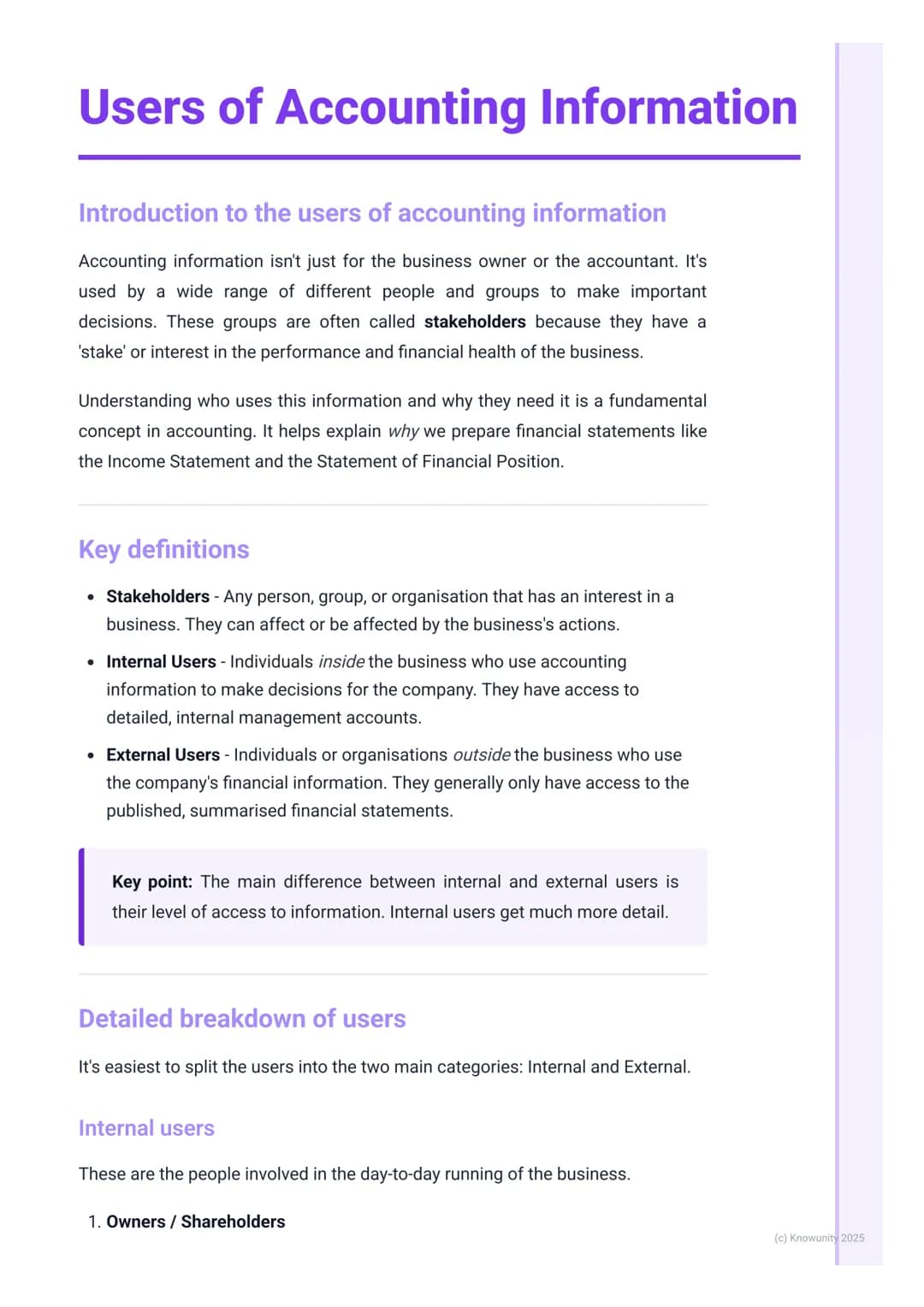
Who Uses Accounting Information?
Think about it - if you were lending your mate €50 or investing in a company, you'd want to know if they're good for the money, right? That's exactly why stakeholders (people with an interest in a business) need accounting information.
The key thing to remember is that users fall into two main camps: internal users (people inside the business) and external users (people outside looking in). Internal users get access to detailed, behind-the-scenes info, while external users only see the published financial statements.
This split matters because it explains why we prepare different types of financial reports - some for internal management and others for public consumption.
Quick Tip: The main difference between internal and external users is their level of access to information - insiders get the full picture!
2
of 6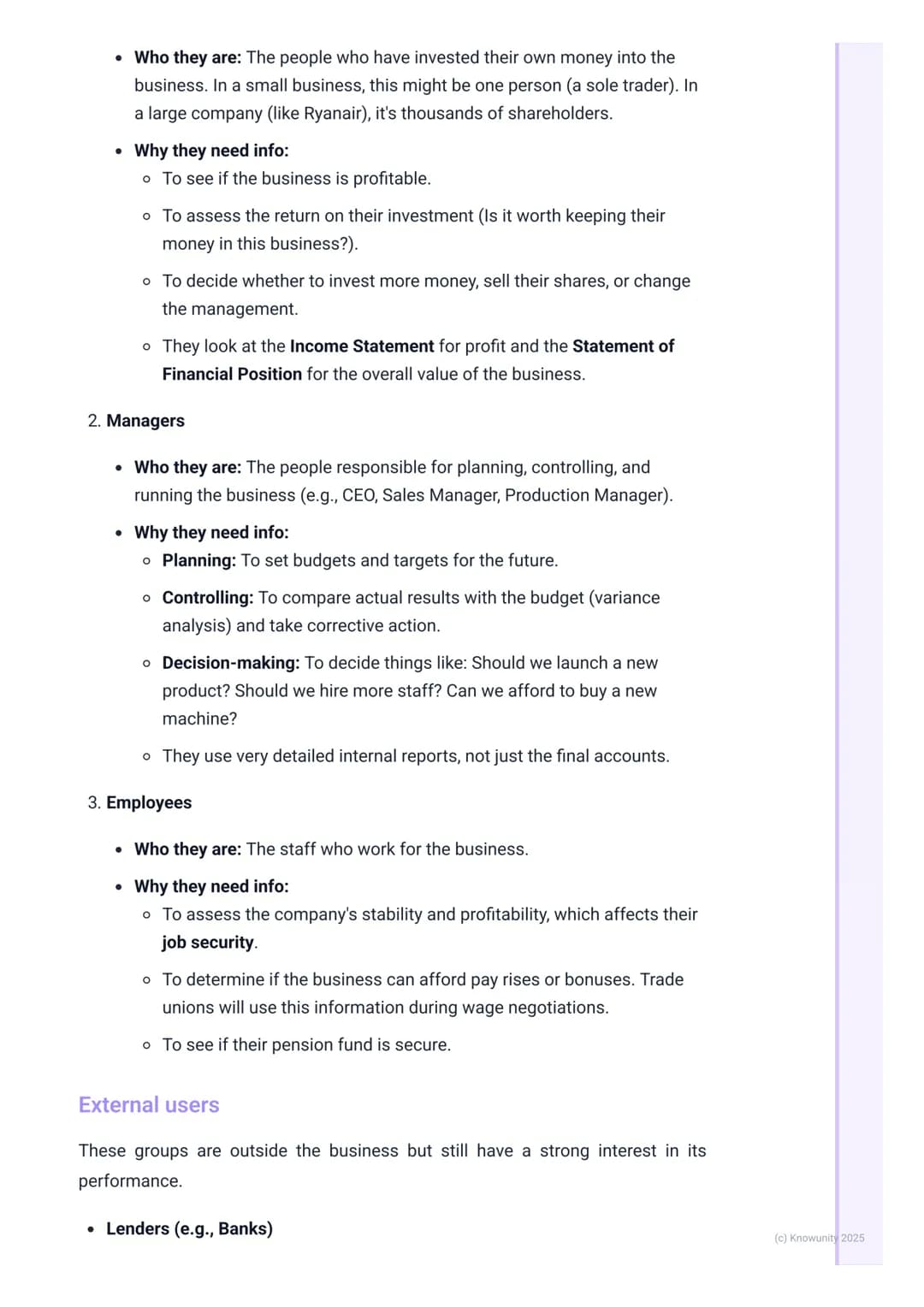
Internal Users: The Insiders
Owners and shareholders are probably the most obvious users - they've put their own cash on the line. They're checking if the business is actually making money and whether their investment is paying off. Small business owners want to see if they're better off than working for someone else, while shareholders in big companies like Ryanair are deciding whether to buy more shares or sell up.
Managers are the people running the show day-to-day. They use accounting info for three main things: planning future budgets, controlling current performance by comparing actual results to targets, and making big decisions like whether to hire more staff or launch new products.
Employees might seem like an odd group, but they've got real skin in the game. They're looking at company performance to gauge job security - nobody wants to work for a sinking ship. Trade unions also use this info during pay negotiations to argue for better wages and conditions.
Remember: Internal users get access to detailed management reports, not just the basic financial statements everyone else sees.
3
of 6
External Users: The Outsiders Looking In
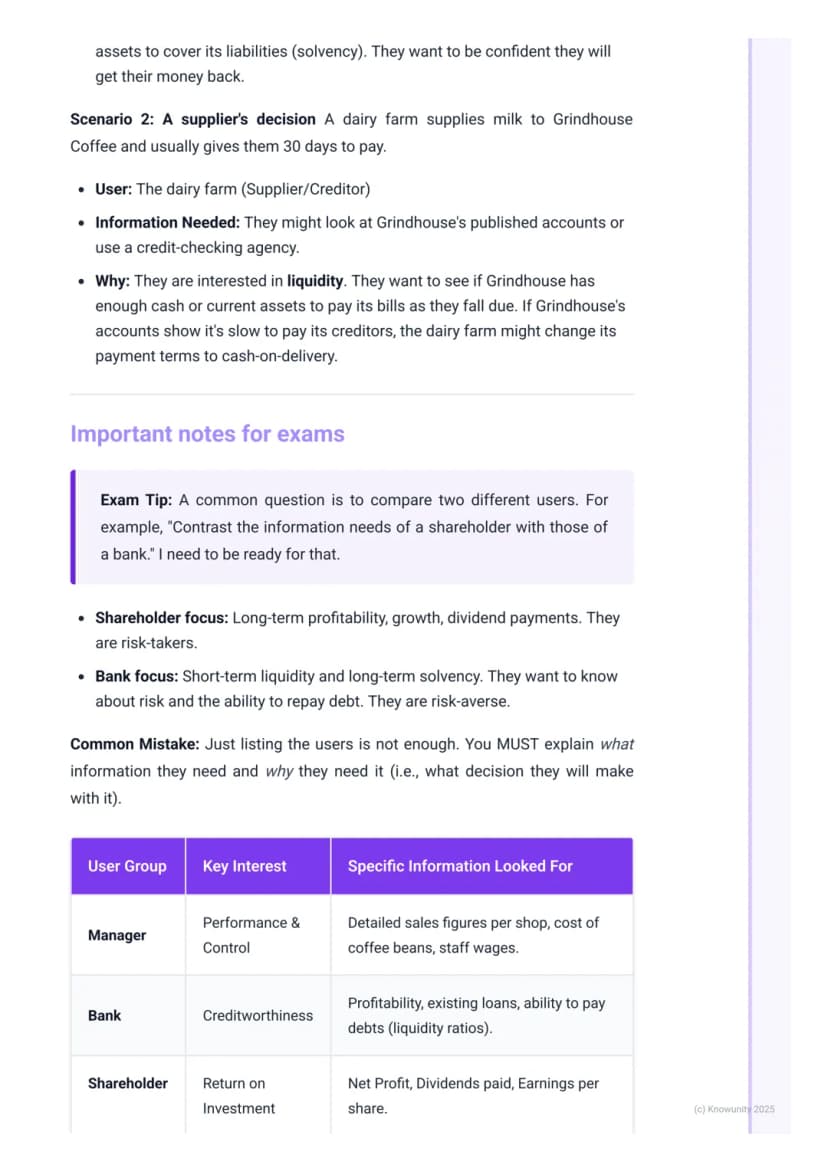
Banks and lenders are basically asking one question: "Will we get our money back?" They're obsessed with three things - can the business pay its short-term bills (liquidity), is it making enough profit to cover interest payments, and is it financially stable long-term (solvency).
Suppliers who sell goods on credit face similar concerns. If a business has dodgy cash flow, suppliers might demand payment upfront rather than offering the usual 30 days credit terms.
The government (specifically Revenue Commissioners in Ireland) needs accurate financial info to make sure businesses are paying the right amount of Corporation Tax, VAT, and employee taxes. Potential investors use financial statements like a crystal ball - analysing past performance to predict if buying shares will make them money.
Even customers have an interest, especially for big purchases. If you're buying a car, you want to know the company will still be around to service it in a few years' time!
Key Point: External users are generally more risk-averse than internal users because they have less control over the business.
4
of 6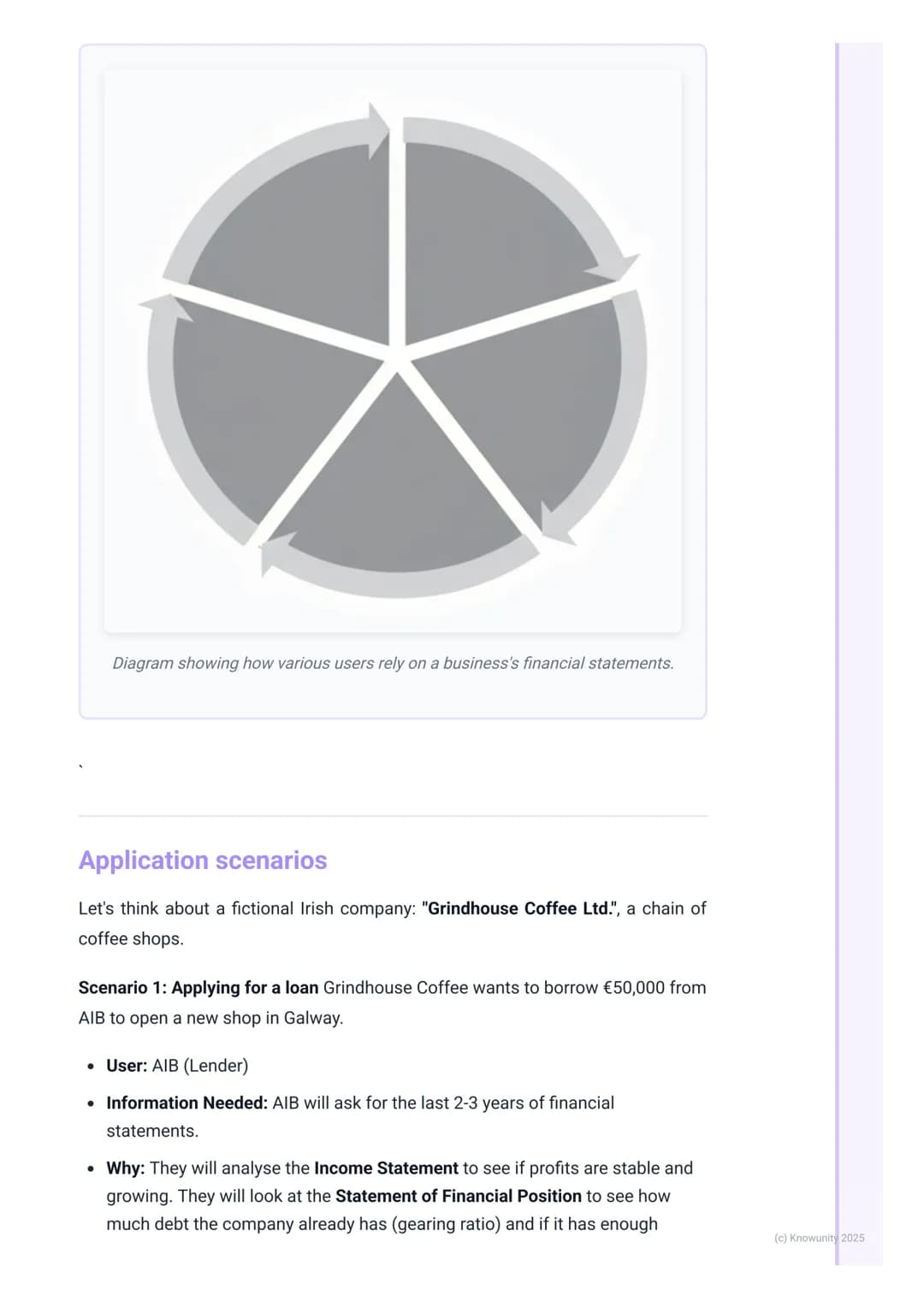
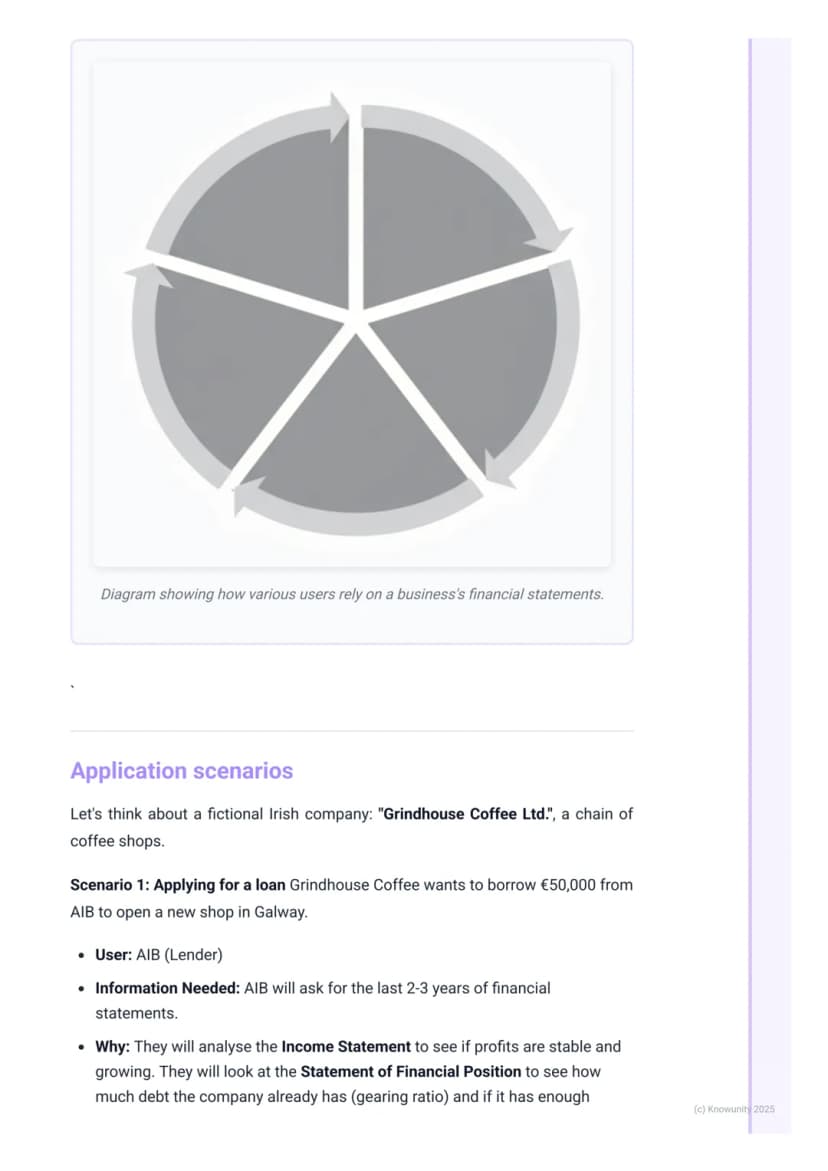
Real-World Example: Grindhouse Coffee Ltd.
Let's say Grindhouse Coffee wants to borrow €50,000 from AIB to open a new shop in Galway. AIB isn't just going to hand over the cash - they'll demand 2-3 years of financial statements first.
They'll scrutinise the Income Statement to check if profits are stable and growing. Then they'll examine the Statement of Financial Position to see existing debt levels and whether assets can cover liabilities. Basically, they're doing financial detective work to assess risk.
Meanwhile, imagine a dairy farm supplies milk to Grindhouse on 30-day credit terms. If Grindhouse's accounts show they're slow payers, that dairy farm might switch to cash-on-delivery pretty quickly.
Exam Alert: Don't just memorise who the users are - you need to explain what specific information they need and why they need it for decision-making.
5
of 6
Key Differences Between User Groups
Here's where exam questions get tricky - comparing different users' needs. Take shareholders versus banks: shareholders are risk-takers focused on long-term profitability, growth, and dividend payments. Banks are risk-averse, obsessing over short-term liquidity and the ability to repay debt.
Managers want nitty-gritty details like sales figures for each shop location, cost of coffee beans, and staff wages. Revenue just wants to calculate the correct Corporation Tax liability from profit figures.
This explains why businesses produce different reports for different audiences. A manager needs daily sales reports, while a potential investor only needs annual financial statements.
Common Mistake: In exams, listing users isn't enough - you must explain what decisions they're making with the information.
6
of 6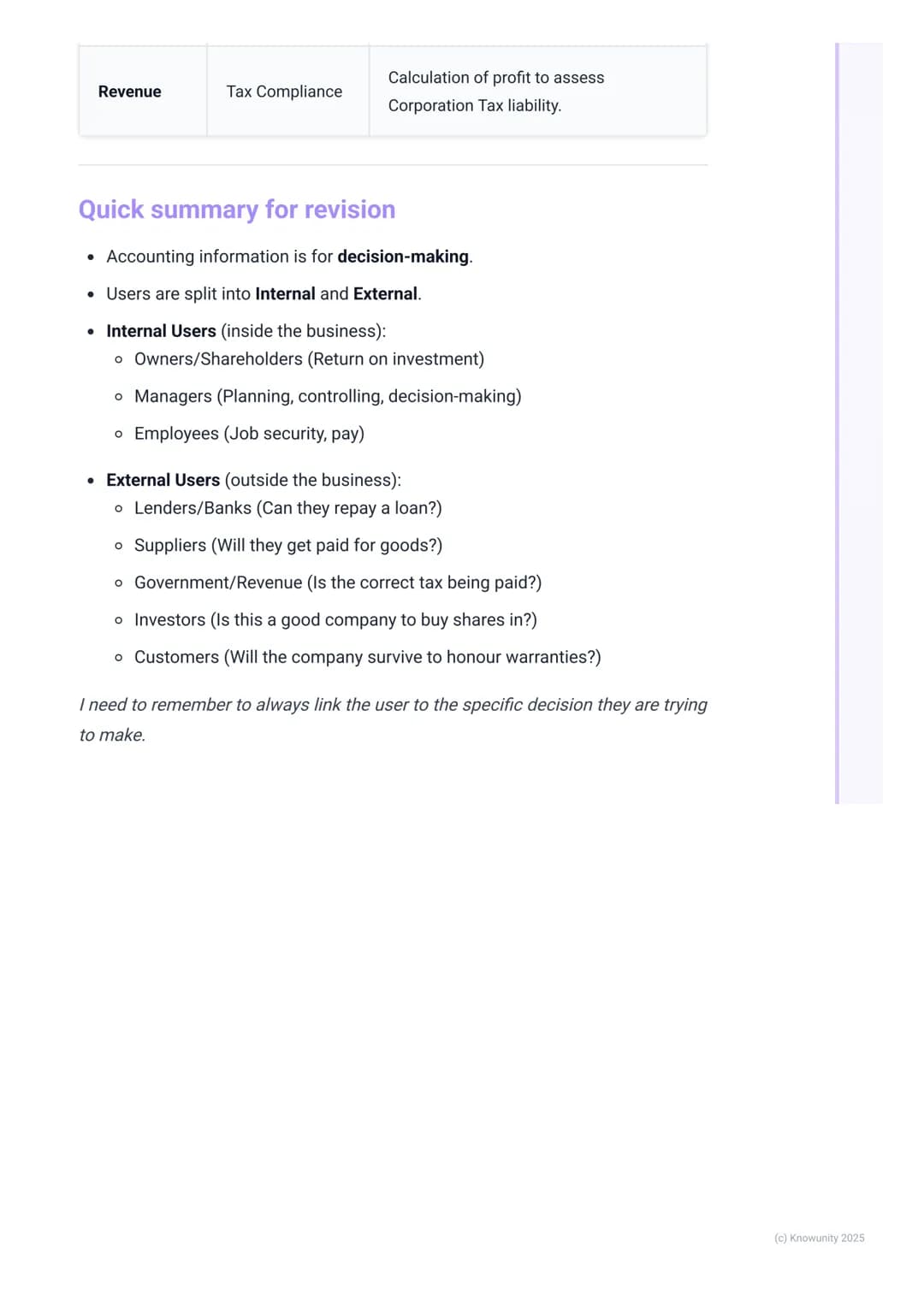
Quick Revision Summary
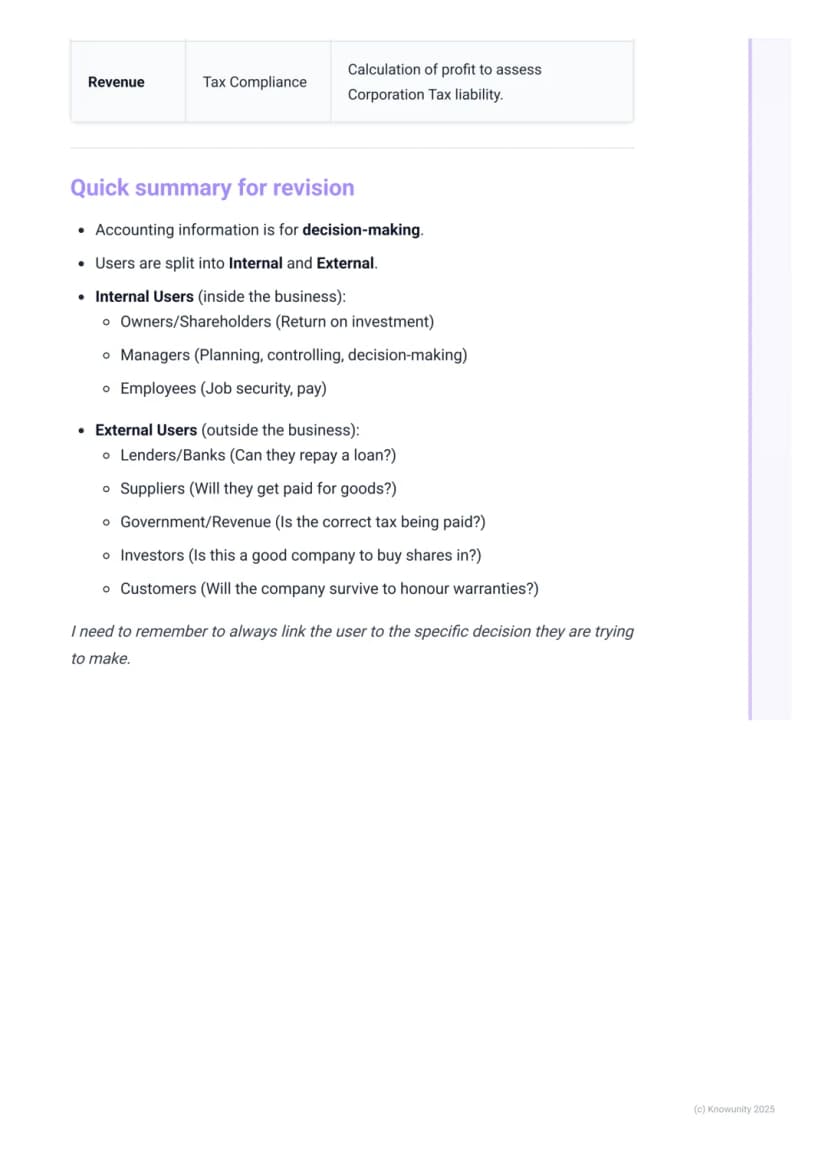
Remember this simple framework: Internal users (owners, managers, employees) have access to detailed info and make operational decisions. External users (banks, suppliers, government, investors, customers) rely on published statements for their own risk assessments.
Each group has specific concerns - banks worry about getting repaid, employees worry about job security, Revenue worries about tax compliance, and customers worry about long-term viability.
The golden rule for exams: always connect each user to their specific decision-making needs. It's not enough to say "shareholders use accounting information" - explain that they use it to assess return on investment and decide whether to buy, hold, or sell shares.
Final Tip: Think about it from each user's perspective - what would you want to know if you were in their shoes?
Pensamos que nunca lo preguntarías...
¿Qué es Knowunity AI companion?
Nuestro compañero de IA está específicamente adaptado a las necesidades de los estudiantes. Basándonos en los millones de contenidos que tenemos en la plataforma, podemos dar a los estudiantes respuestas realmente significativas y relevantes. Pero no se trata solo de respuestas, el compañero también guía a los estudiantes a través de sus retos de aprendizaje diarios, con planes de aprendizaje personalizados, cuestionarios o contenidos en el chat y una personalización del 100% basada en las habilidades y el desarrollo de los estudiantes.
¿Dónde puedo descargar la app Knowunity?
Puedes descargar la app en Google Play Store y Apple App Store.
¿Knowunity es totalmente gratuito?
¡Sí lo es! Tienes acceso totalmente gratuito a todo el contenido de la app, puedes chatear con otros alumnos y recibir ayuda inmeditamente. Puedes ganar dinero utilizando la aplicación, que te permitirá acceder a determinadas funciones.
Contenidos más populares
9 Irish
IrishIrish oral questions and answers
Questions and answers for the leaving cert oral
5th Year4264
 English
Key Quotes : Sive
Key Quotes and explanations: Sive
6th Year2842
IrishIrish oral questions
Outline of oral questions
5th Year2055
IrishIníon- le hÁine Durkin
Aine Durkin’s poem, Iníon: Themes & summary
5th Year850
IrishIrish poetry 2027
Iníon + Dínit an Bhróin
5th Year1133
IrishLC HL notes- Iníon (poem)
Includes poem in English and Irish, theme, key words & phrases
5th Year2284
EnglishCultural Context : Shawshank Redemption : Sive : Small Things Like These
Comparative Study : Cultural Context : Shawshank Redemption, Sive and Small Things Like These
6th Year1430
IrishMo Ghrá-sa (Idir Lúibíní)
Notes on mo ghrá-sa
5th Year380
IrishAn Gaeilge Aiste
Irish Language essay
6th Year1320
¿No encuentras lo que buscas? Explora otros temas.
Mira lo que dicen nuestros usuarios. Les encantó — y a ti también te encantará.
4.6/5App Store
4.7/5Google Play
La app es muy fácil de usar y está muy bien diseñada. Hasta ahora he encontrado todo lo que estaba buscando y he podido aprender mucho de las presentaciones. Definitivamente utilizaré la aplicación para un examen de clase. Y, por supuesto, también me sirve mucho de inspiración.
Pablousuario de iOS
Esta app es realmente genial. Hay tantos apuntes de clase y ayuda [...]. Tengo problemas con matemáticas, por ejemplo, y la aplicación tiene muchas opciones de ayuda. Gracias a Knowunity, he mejorado en mates. Se la recomiendo a todo el mundo.
Elenausuaria de Android
Vaya, estoy realmente sorprendida. Acabo de probar la app porque la he visto anunciada muchas veces y me he quedado absolutamente alucinada. Esta app es LA AYUDA que quieres para el insti y, sobre todo, ofrece muchísimas cosas, como ejercicios y hojas informativas, que a mí personalmente me han sido MUY útiles.
Anausuaria de iOS
Accounting12 visualizaciones·Actualizado Jun 11, 2026·6 páginasUnderstanding Who Uses Accounting Information
Ever wonder who actually looks at those financial statements businesses create? It's not just boring accountants - loads of different people use accounting information to make important decisions that affect their money and livelihoods.
1
of 6
Inscríbete para ver los apuntes. ¡Es gratis!
- Acceso a todos los documentos
- Mejora tus notas
- Únete a millones de estudiantes
Who Uses Accounting Information?
Think about it - if you were lending your mate €50 or investing in a company, you'd want to know if they're good for the money, right? That's exactly why stakeholders (people with an interest in a business) need accounting information.
The key thing to remember is that users fall into two main camps: internal users (people inside the business) and external users (people outside looking in). Internal users get access to detailed, behind-the-scenes info, while external users only see the published financial statements.
This split matters because it explains why we prepare different types of financial reports - some for internal management and others for public consumption.
Quick Tip: The main difference between internal and external users is their level of access to information - insiders get the full picture!
2
of 6Inscríbete para ver los apuntes. ¡Es gratis!
- Acceso a todos los documentos
- Mejora tus notas
- Únete a millones de estudiantes
Internal Users: The Insiders
Owners and shareholders are probably the most obvious users - they've put their own cash on the line. They're checking if the business is actually making money and whether their investment is paying off. Small business owners want to see if they're better off than working for someone else, while shareholders in big companies like Ryanair are deciding whether to buy more shares or sell up.
Managers are the people running the show day-to-day. They use accounting info for three main things: planning future budgets, controlling current performance by comparing actual results to targets, and making big decisions like whether to hire more staff or launch new products.
Employees might seem like an odd group, but they've got real skin in the game. They're looking at company performance to gauge job security - nobody wants to work for a sinking ship. Trade unions also use this info during pay negotiations to argue for better wages and conditions.
Remember: Internal users get access to detailed management reports, not just the basic financial statements everyone else sees.
3
of 6Inscríbete para ver los apuntes. ¡Es gratis!
- Acceso a todos los documentos
- Mejora tus notas
- Únete a millones de estudiantes
External Users: The Outsiders Looking In
Banks and lenders are basically asking one question: "Will we get our money back?" They're obsessed with three things - can the business pay its short-term bills (liquidity), is it making enough profit to cover interest payments, and is it financially stable long-term (solvency).
Suppliers who sell goods on credit face similar concerns. If a business has dodgy cash flow, suppliers might demand payment upfront rather than offering the usual 30 days credit terms.
The government (specifically Revenue Commissioners in Ireland) needs accurate financial info to make sure businesses are paying the right amount of Corporation Tax, VAT, and employee taxes. Potential investors use financial statements like a crystal ball - analysing past performance to predict if buying shares will make them money.
Even customers have an interest, especially for big purchases. If you're buying a car, you want to know the company will still be around to service it in a few years' time!
Key Point: External users are generally more risk-averse than internal users because they have less control over the business.
4
of 6Inscríbete para ver los apuntes. ¡Es gratis!
- Acceso a todos los documentos
- Mejora tus notas
- Únete a millones de estudiantes
Real-World Example: Grindhouse Coffee Ltd.
Let's say Grindhouse Coffee wants to borrow €50,000 from AIB to open a new shop in Galway. AIB isn't just going to hand over the cash - they'll demand 2-3 years of financial statements first.
They'll scrutinise the Income Statement to check if profits are stable and growing. Then they'll examine the Statement of Financial Position to see existing debt levels and whether assets can cover liabilities. Basically, they're doing financial detective work to assess risk.
Meanwhile, imagine a dairy farm supplies milk to Grindhouse on 30-day credit terms. If Grindhouse's accounts show they're slow payers, that dairy farm might switch to cash-on-delivery pretty quickly.
Exam Alert: Don't just memorise who the users are - you need to explain what specific information they need and why they need it for decision-making.
5
of 6Inscríbete para ver los apuntes. ¡Es gratis!
- Acceso a todos los documentos
- Mejora tus notas
- Únete a millones de estudiantes
Key Differences Between User Groups
Here's where exam questions get tricky - comparing different users' needs. Take shareholders versus banks: shareholders are risk-takers focused on long-term profitability, growth, and dividend payments. Banks are risk-averse, obsessing over short-term liquidity and the ability to repay debt.
Managers want nitty-gritty details like sales figures for each shop location, cost of coffee beans, and staff wages. Revenue just wants to calculate the correct Corporation Tax liability from profit figures.
This explains why businesses produce different reports for different audiences. A manager needs daily sales reports, while a potential investor only needs annual financial statements.
Common Mistake: In exams, listing users isn't enough - you must explain what decisions they're making with the information.
6
of 6Inscríbete para ver los apuntes. ¡Es gratis!
- Acceso a todos los documentos
- Mejora tus notas
- Únete a millones de estudiantes
Quick Revision Summary
Remember this simple framework: Internal users (owners, managers, employees) have access to detailed info and make operational decisions. External users (banks, suppliers, government, investors, customers) rely on published statements for their own risk assessments.
Each group has specific concerns - banks worry about getting repaid, employees worry about job security, Revenue worries about tax compliance, and customers worry about long-term viability.
The golden rule for exams: always connect each user to their specific decision-making needs. It's not enough to say "shareholders use accounting information" - explain that they use it to assess return on investment and decide whether to buy, hold, or sell shares.
Final Tip: Think about it from each user's perspective - what would you want to know if you were in their shoes?
Pensamos que nunca lo preguntarías...
¿Qué es Knowunity AI companion?
Nuestro compañero de IA está específicamente adaptado a las necesidades de los estudiantes. Basándonos en los millones de contenidos que tenemos en la plataforma, podemos dar a los estudiantes respuestas realmente significativas y relevantes. Pero no se trata solo de respuestas, el compañero también guía a los estudiantes a través de sus retos de aprendizaje diarios, con planes de aprendizaje personalizados, cuestionarios o contenidos en el chat y una personalización del 100% basada en las habilidades y el desarrollo de los estudiantes.
¿Dónde puedo descargar la app Knowunity?
Puedes descargar la app en Google Play Store y Apple App Store.
¿Knowunity es totalmente gratuito?
¡Sí lo es! Tienes acceso totalmente gratuito a todo el contenido de la app, puedes chatear con otros alumnos y recibir ayuda inmeditamente. Puedes ganar dinero utilizando la aplicación, que te permitirá acceder a determinadas funciones.
Contenidos más populares
9IrishIrish oral questions and answers
Questions and answers for the leaving cert oral
5th Year4264
EnglishKey Quotes : Sive
Key Quotes and explanations: Sive
6th Year2842
IrishIrish oral questions
Outline of oral questions
5th Year2055
IrishIníon- le hÁine Durkin
Aine Durkin’s poem, Iníon: Themes & summary
5th Year850
IrishIrish poetry 2027
Iníon + Dínit an Bhróin
5th Year1133
IrishLC HL notes- Iníon (poem)
Includes poem in English and Irish, theme, key words & phrases
5th Year2284
EnglishCultural Context : Shawshank Redemption : Sive : Small Things Like These
Comparative Study : Cultural Context : Shawshank Redemption, Sive and Small Things Like These
6th Year1430
IrishMo Ghrá-sa (Idir Lúibíní)
Notes on mo ghrá-sa
5th Year380
IrishAn Gaeilge Aiste
Irish Language essay
6th Year1320
¿No encuentras lo que buscas? Explora otros temas.
Mira lo que dicen nuestros usuarios. Les encantó — y a ti también te encantará.
4.6/5App Store
4.7/5Google Play
La app es muy fácil de usar y está muy bien diseñada. Hasta ahora he encontrado todo lo que estaba buscando y he podido aprender mucho de las presentaciones. Definitivamente utilizaré la aplicación para un examen de clase. Y, por supuesto, también me sirve mucho de inspiración.
Pablousuario de iOS
Esta app es realmente genial. Hay tantos apuntes de clase y ayuda [...]. Tengo problemas con matemáticas, por ejemplo, y la aplicación tiene muchas opciones de ayuda. Gracias a Knowunity, he mejorado en mates. Se la recomiendo a todo el mundo.
Elenausuaria de Android
Vaya, estoy realmente sorprendida. Acabo de probar la app porque la he visto anunciada muchas veces y me he quedado absolutamente alucinada. Esta app es LA AYUDA que quieres para el insti y, sobre todo, ofrece muchísimas cosas, como ejercicios y hojas informativas, que a mí personalmente me han sido MUY útiles.
Anausuaria de iOS